


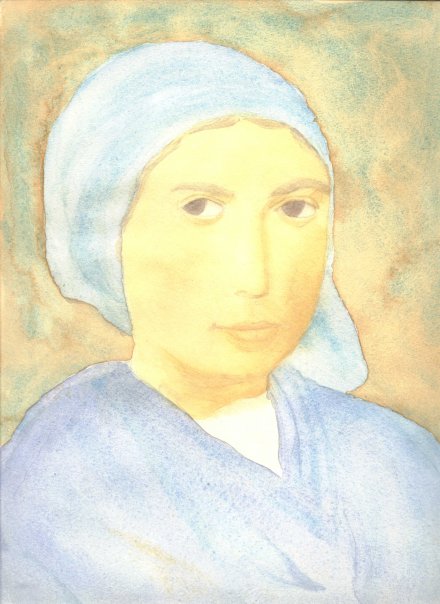
OK, I think I've figured out a routine. I paint, I post, I blog. I bet that sounds cool in Latin. This week's blog is going to be about saints. I have made several paintings of saints and my newest one is of Saint Hildegard. More on her later; right now I want to talk about paintings of saints and saints in general. As I have stated in previous posts; I like painting saints because I consider it like a meditation on a holy subject. I study the saint, I spend time and energy concentrating on the saint and his or her actions even as I paint the picture. I also feel like the resulting painting might bring someone some kind of solace to see it or to have a copy for themselves.
There is certainly no shortage of paintings of saints in the history of art. The Church has been a major sponsor of artists throughout its existence. In fact in pre-renaissance times, art music and writing had to dedicated to the church or the reining monarch of the land. Of course there was art created that was not and we call that folk art. folk art is usually considered less refined and less valuable than fine art.
With the rise of the merchant class and education among the laity, the demand for secular art rose. Then further, with the advent of Protestantism, even representation of religious subjects evolved. Landscapes became metaphors for creation and holy things. Religious wars caused a reliance on coded paintings; ie, lilies represented the Resurrection, and roses were a symbol of the Virgin Mary. These symbols existed previous to these times but became more prevalent due to religious persecution and the evolution of art in general.
As art continued to evolve throughout the ages, religious art changed accordingly; the baroque through modern times have their own symbols and styles specific to themselves. In today's post modern world, I open art magazines and visit galleries and museums and it seems that artists are free to follow their preferences. I see no overarching movement that artists have to conform to or be part of to ride the popular wave of the times.
My paintings are generally in watercolor, though I often then run them through photoshop, their style is simply marked by habits I have formed through years of painting. As I said I research the subject and try to put it in the proper time; ie, costumes and the like. There is a long tradition of clothing biblical characters in contemporary clothing and local scenery and ethnicity. Sometimes I might employ these techniques for the purposes of making a point to the viewer, but in general it seems like you're doing your homework if you take pains to use proper context, and you're not if you don't.
As for my new painting of Saint Hildegard, I decided to do another saint painting as a friend of mine has expressed interest in having a collection of them. St Hildegard was a lady who lived in the early 12th century. She had seen visions since she was 5yrs old. as the 10th child and perhaps because she was sickly (her visions were accompanied by migraine headaches) her parents tithed her to the church (they get a 10th of everything you own, you know). She became a Benedictine nun when she was 14, and became abbess when she was 39. When she was 42, her visions commanded her to write them down. She also was an herbalist, and a composer of sacred music. This was all very prolific for a woman of her times. I first heard about her through a recording of her music made by Anonymous4, a favorite group of mine. At a sacred book shop, I stumbled upon a book of her work; Scivias, just as I was looking for a new project. I was blown away by the poetry and beauty of the imagery.
I set the painting in a forest near the first abbey she was stationed at and depicted her as a young woman. She is usually depicted as older because that is when she began to chronicle her visions, but she had been a nun since she was a teenager, and a visionary since she was five, and I felt like this period of her life is often glossed over. She is shown in the midst of an ecstatic vision, and the forest represents one of her major themes; green nature. my reference material is actually of the forest her abbey Disibodenberg was situated in.
There is certainly no shortage of paintings of saints in the history of art. The Church has been a major sponsor of artists throughout its existence. In fact in pre-renaissance times, art music and writing had to dedicated to the church or the reining monarch of the land. Of course there was art created that was not and we call that folk art. folk art is usually considered less refined and less valuable than fine art.
With the rise of the merchant class and education among the laity, the demand for secular art rose. Then further, with the advent of Protestantism, even representation of religious subjects evolved. Landscapes became metaphors for creation and holy things. Religious wars caused a reliance on coded paintings; ie, lilies represented the Resurrection, and roses were a symbol of the Virgin Mary. These symbols existed previous to these times but became more prevalent due to religious persecution and the evolution of art in general.
As art continued to evolve throughout the ages, religious art changed accordingly; the baroque through modern times have their own symbols and styles specific to themselves. In today's post modern world, I open art magazines and visit galleries and museums and it seems that artists are free to follow their preferences. I see no overarching movement that artists have to conform to or be part of to ride the popular wave of the times.
My paintings are generally in watercolor, though I often then run them through photoshop, their style is simply marked by habits I have formed through years of painting. As I said I research the subject and try to put it in the proper time; ie, costumes and the like. There is a long tradition of clothing biblical characters in contemporary clothing and local scenery and ethnicity. Sometimes I might employ these techniques for the purposes of making a point to the viewer, but in general it seems like you're doing your homework if you take pains to use proper context, and you're not if you don't.
As for my new painting of Saint Hildegard, I decided to do another saint painting as a friend of mine has expressed interest in having a collection of them. St Hildegard was a lady who lived in the early 12th century. She had seen visions since she was 5yrs old. as the 10th child and perhaps because she was sickly (her visions were accompanied by migraine headaches) her parents tithed her to the church (they get a 10th of everything you own, you know). She became a Benedictine nun when she was 14, and became abbess when she was 39. When she was 42, her visions commanded her to write them down. She also was an herbalist, and a composer of sacred music. This was all very prolific for a woman of her times. I first heard about her through a recording of her music made by Anonymous4, a favorite group of mine. At a sacred book shop, I stumbled upon a book of her work; Scivias, just as I was looking for a new project. I was blown away by the poetry and beauty of the imagery.
I set the painting in a forest near the first abbey she was stationed at and depicted her as a young woman. She is usually depicted as older because that is when she began to chronicle her visions, but she had been a nun since she was a teenager, and a visionary since she was five, and I felt like this period of her life is often glossed over. She is shown in the midst of an ecstatic vision, and the forest represents one of her major themes; green nature. my reference material is actually of the forest her abbey Disibodenberg was situated in.
There are also many saints of India and many other cultures around the world. If I can, in some small way through my art and through my actions, I would like to put them all under one roof and demonstrate to the world that all the paths lead to the same source.


